Neptune Play Licence and Safety: UKGC Status and Player Protections
 Available in GB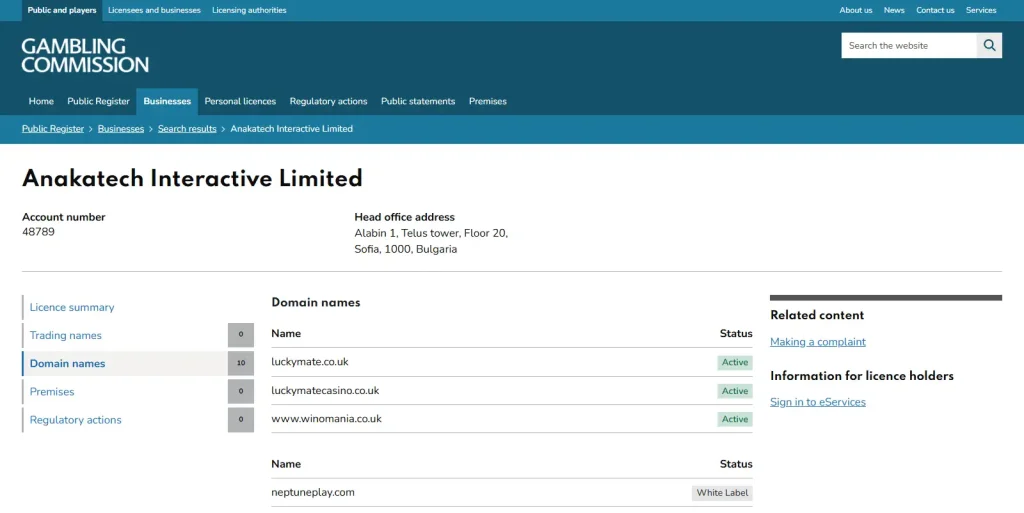
UK licence check
The current UK Gambling Commission register maps neptuneplay.com to Anakatech Interactive Limited, account 48789, where the domain is listed as White Label and the Casino Remote licence is active. Older UKGC material can also connect Neptune Play with AG Communications account 39483, but the domain is now marked Inactive on that older account. That makes the current mapping clear without turning a licence record into a blanket judgment about product quality or every player experience.
Table of Contents
- Current UKGC record for neptuneplay.com
- What White Label status means
- UK player-protection rules that matter
- Why old AG Communications licence data still appears
- How to verify Neptune Play in the UKGC register
- What the licence record does not prove by itself
- What the UKGC record tells you about Neptune Play today
Current UKGC record for neptuneplay.com
The current Gambling Commission public register lists neptuneplay.com under Anakatech Interactive Limited, account number 48789, with the domain status shown as White Label. The same business record shows an active Casino Remote licence under number 048789-R-327402-013.
That is the most useful starting point for a UK licence check because it ties the exact domain to a current Commission business account. It is stronger evidence than a review page that merely says a casino is “UK licensed” without naming the licence holder or account.
The account also carries active remote betting permissions, but those do not change the basic point for this casino review: the relevant current operator record for the Neptune Play domain is Anakatech account 48789. A domain mapping is particularly useful with white-label sites because the consumer-facing brand name may not match the legal licensee name shown in the register.
The licence record establishes a regulatory relationship and applicable obligations. It does not show whether every product feature is good, whether a particular withdrawal will be fast, or whether every customer will have the same experience.
For the wider product overview, return to the Neptune Play review. For the account checks that flow from UK rules, see the identity checks.
Reading the record in this order avoids a common source of confusion. Start with the exact domain, then confirm the business account it is attached to, and only then read the licence activities on that same account. Seeing the Neptune Play name in an older result is not enough because the historical AG Communications entry still exists in the register. The useful current-state check is whether neptuneplay.com is listed on the Anakatech account and what status is shown for that domain entry.
The account number is also valuable when two company records appear in search results. Names and trading labels can be similar or change over time, but the register account gives a specific reference point. For Neptune Play, account 48789 identifies the current Anakatech record discussed here, while account 39483 identifies the older AG Communications record. Keeping those references separate prevents a historical licence relationship from being described as the present one.
What White Label status means
“White Label” is the status the UKGC register currently displays next to neptuneplay.com under Anakatech’s account. The practical meaning is that the consumer-facing Neptune Play domain is mapped in the regulator’s database to the named licence-holder account rather than appearing as an Anakatech trading name.
The brand name shown to players does not have to be the legal company holding the operating licence. The UKGC trading-names page for Anakatech currently shows no recorded trading names, while its domain page separately lists active and white-label domains.
White-label status by itself does not prove who owns the Neptune Play brand, who designed its interface, or which group ultimately controls every commercial decision. The public register shows that neptuneplay.com is presently listed as a White Label domain on Anakatech Interactive Limited account 48789.
This matters when checking terms, complaints or older reviews. A document that names a different historic licensee can be genuine for an earlier period yet still be stale for the current domain mapping. Always compare the exact domain and the current register status rather than relying only on a company name copied from an old review.
For a reader, the safest way to use that register entry is to keep four fields together: the exact domain, the named company, the account number and the status shown for the domain. If an older article names a different operator, compare those fields before deciding that the sources truly conflict. The brand name alone is not enough because the register can associate a consumer-facing domain with a licence-holder account without recording the brand as a trading name. That is the distinction visible in Neptune Play’s current record.
This also explains why licence checking should be narrower than a general reputation check. The UKGC record can answer who the domain is mapped to and whether the relevant remote licence is active, but it does not tell you whether a particular game is in the lobby, what a current promotion pays, or which cashier method your account will show. Those product questions need their own current checks. Keeping the regulatory record in its proper role avoids both understating it and treating it as proof of unrelated commercial details.
UK player-protection rules that matter
A current Great Britain remote licence brings concrete player-protection rules. Identity is one example: applicable remote operators must establish a customer’s identity before gambling, with name, address and date of birth among the minimum information. They also must not wait until a withdrawal request to demand information that could reasonably have been requested earlier, although later information can still be required where another legal obligation arises.
GAMSTOP is another part of the UK framework. Great Britain online operators within scope of the remote multi-operator self-exclusion requirement participate in the national scheme, so self-exclusion is intended to work across participating licensed sites rather than as a single-brand setting. It is not a feature that should be bypassed by creating altered account details.
Credit cards cannot be used for online casino gambling in Great Britain. That rule matters when reading generic payment lists because a payment method that exists internationally is not automatically permitted for a UK-facing remote casino. See the UK payment rules for the UK payment rules and associated methods.
Online slots also have statutory stake caps. Since 2025, the maximum per game cycle is £5 for customers aged 25 and over and £2 for customers aged 18 to 24. The limits apply to online slots, not automatically to every casino game such as roulette or blackjack.
These rules are useful because they are regulator-backed and do not depend on marketing copy. They are also limited in scope. Compliance requirements tell you what licensed operators must do; they do not tell you whether a particular bonus is attractive or whether customer service will answer quickly.
The same separation applies to responsible-gambling tools. A licensed operator’s participation in required protection systems is a regulatory fact, while the usability of those tools is a product-experience question. A licence record can therefore confirm the framework that applies without settling how intuitive a control feels on a particular device.
The practical value of those rules is that they set boundaries around several different parts of the player journey. Identity verification concerns who is using the account; GAMSTOP concerns self-exclusion; the credit-card prohibition concerns how remote gambling can be funded; and slot stake limits concern the product itself. They should not be collapsed into one vague claim that a site is simply “safe”. A licence check is stronger when the reader can connect each rule to the specific account, payment or game decision it governs.
Why old AG Communications licence data still appears
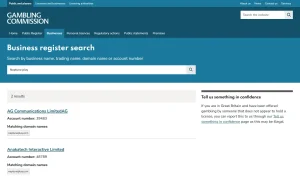
A UKGC search for Neptune Play currently returns two business records connected with the domain. Alongside Anakatech account 48789, the register still finds AG Communications Limited, account 39483. On the AG Communications domain page, however, neptuneplay.com is marked Inactive.
That is why older reviews, cached pages or historic compliance material can associate Neptune Play with AG Communications. The association is not invented: the Commission’s own 2025 public statement about AG Communications refers to the Neptuneplay.com white-label site in connection with historic compliance findings. But that historic reference should not be presented as the current domain mapping when the current domain table under account 39483 says Inactive and the Anakatech table lists the domain as White Label.
AG Communications itself still has active remote licence activities in the UKGC register. The important distinction is therefore not “AG Communications no longer has a licence”. The precise distinction is that neptuneplay.com is inactive on AG Communications account 39483 while it is currently listed as White Label on Anakatech account 48789.
Keeping those statements separate resolves the apparent contradiction without rewriting history. The Neptune Play current status page gives the fuller operator-status timeline.
There is another reason to keep the two records distinct. In 2025, the Commission published regulatory action involving AG Communications and specifically referred to the Neptuneplay.com white-label site in its findings. That historical enforcement material is relevant to the earlier operator relationship, but it should not be silently carried forward as if it described the current Anakatech mapping. Current status and historical compliance evidence answer different questions.
How to verify Neptune Play in the UKGC register
The most reliable check is domain-first. Open the Gambling Commission public register and search for neptuneplay.com, not just “Neptune Play”. A domain search reduces ambiguity because consumer brand names can be reused, styled differently or attached to a white-label arrangement.
On the current result, open the Anakatech Interactive Limited record and confirm account number 48789. Then open its domain-names section and find neptuneplay.com. The status should be read from that row. Next, return to the licence summary for the same account and check whether the relevant remote casino activity is active.
If an older source names AG Communications account 39483, open that account’s domain-names page as well. The current table marks neptuneplay.com Inactive there. This two-record comparison is more informative than merely seeing that both companies appear in search results.
The UKGC notes that domain and trading-name information is supplied by businesses and that it cannot guarantee the accuracy of third-party supplied information. Confirm the exact domain, account number and displayed status rather than relying on a generic licence badge.
When comparing records, note the domain, account number, domain status and licence activity status. If one of those fields changes, that shows exactly what changed instead of reducing the situation to broad statements such as “licensed” or “not licensed.” This is especially useful for white-label brands, where the visible casino name can stay constant while the legal mapping behind a domain changes.
When checking again later, repeat the same domain-first method instead of relying on a saved image or old article. A current domain row and the account number attached to it are the clearest way to see whether the mapping has changed. This is especially useful for a white-label brand because the consumer-facing name and the licensed company name do not have to be identical.
What the licence record does not prove by itself
A current UKGC domain mapping answers a regulatory identity question. It does not prove that a welcome offer is competitive, that withdrawals take a particular number of hours, that support is available around the clock, or that the game catalogue is broader than a rival’s. Those require their own evidence.
It also should not be converted into a universal “safe” score. Licensing creates enforceable obligations and a regulator relationship, but consumer experience can still vary and licensed companies can still face regulatory action. Historic action involving a previous Neptune Play mapping is one reason to keep licence status and service-quality judgments analytically separate.
The register also does not replace the terms that govern an individual account. Check promotional eligibility in the live promotion terms, payment availability in the cashier, and verification requests in the secure account area rather than inferring those details from the presence of an active remote licence.
Use the register to verify who the domain is mapped to and what licence activities are current. Use the rest of the site for separate questions about payments, games, bonuses and account experience.
That separation also makes future checks easier: if the licence mapping changes, product claims do not have to be reinterpreted as part of the same regulatory question.
What the UKGC record tells you about Neptune Play today
The UKGC register lists neptuneplay.com as a White Label domain under Anakatech Interactive Limited account 48789, whose Casino Remote licence is active. The same domain is still searchable under AG Communications account 39483 but is marked Inactive there.
That record identifies the current Great Britain regulatory mapping and the UK rules that apply. It does not, on its own, promise a particular withdrawal speed, bonus quality or customer-service outcome. Assess product terms and account conditions separately from the licence mapping.
For a player, the practical use of the register is precise but limited. It can establish the current regulatory mapping of the domain and provide the licence record to inspect, while the casino itself remains the place to check live product terms, payment options and account conditions. Using each source for the question it actually answers gives a clearer picture than treating a licence entry as a substitute for every other product check.